CoursesAbout UsCompare
Is Accounting a good course to study in Nigeria?

Accounting Salary in Nigeria: Jobs, Internships, ICAN & Career Paths

Before you choose or accept Accounting as the course you want to study in Uni or Poly, don't start by asking only, “Is Accounting a good course to study in Nigeria?” Start with a more realistic question:
  • Does Accounting has more jobs opportunities in Nigeria? 
  • Is it worth to invest my money, time and 4-5 years in school studying Accounting? 
  • Will I get job easily after graduation?
 That is the question we started with at Careerlator. We looked at the Nigerian job market, current Accounting and Finance vacancies, how often those vacancies are advertised, salaries, role descriptions, the qualifications and certifications employers ask for, among many others.

The picture is clear: there are high job opportunities for Accounting and Finance graduates in Nigeria, and yes, there is a high possibility of getting a job after graduation.

Is Accounting a good course to study in Nigeria in 2026? →
Jobs opportunitiesHigh
Most required certificationICAN (mandatory in 52.4% of observed jobs requirements)
Most needed rolesAccounts Officer, Audit Associate, Financial Reporting Accountant
Monthly Salary₦120K - ₦450K for Entry and Mid-level roles
On This PageCourse overview
↗
How Careerlator reads the Accounting labour market
For Accounting, Careerlator tracks how often accounting jobs vacancies are announced, the functions employers use Accounting graduates for: financial reporting, accounts operations, audit, tax, compliance, controls, analysis and finance systems. We study the requirements behind those roles, because employers use a wide range of job titles.
MARKET TRENDAccounting has more job opportunities in Nigeria. There is a steady market demand for Accountants in the Nigerian jobs market.
Nigerian cities with the most high-paying roles for fresh Accountants include Lagos, Abuja, Rivers, Ogun and some parts of South South. The high market demand is supported by the fact that businesses of all sizes need accounting, financial reporting, taxation, payroll, auditing and compliance functions, although competition is higher for entry-level positions and employers increasingly value practical skills and professional qualifications alongside an Accounting degree.
Demand over time

Demand Trend

Jobs Market demand for Accounting graduates in Nigeria over time.

RecordedModel estimate161K128.8K96.6K64.4K32.2K0Job postings2027 — 56.6K model estimate2028 — 64.4K model estimate2029 — 70.6K model estimate2030 — 75.3K model estimate2031 — 79K model estimateFORECAST2021 — 5.9K recorded job postings2022 — 14.4K recorded job postings2023 — 9.5K recorded job postings2024 — 12.1K recorded job postings2025 — 55.2K recorded job postings2026 — 46.6K recorded job postings20212022202320242025202620272028202920302031Year
MODEL FORECAST

Where the market could be heading

Projected from the historical Demand Trend data. Forecasts are estimates, not guarantees.

5-year projection79Kmodel estimate for 2031 · range 0–160.5K
Approx. graduation outlook75.3Kmodel estimate for 2030 · range 2.3K–148.3K
The shaded model range reflects increasing uncertainty with forecast distance. The model uses only the course's historical Demand Trend observations; it is an estimate, not a prediction guarantee, and actual future hiring can differ.
Trend interpretationThis chart shows how the market demand for Accountants in Nigeria has been growing over time.
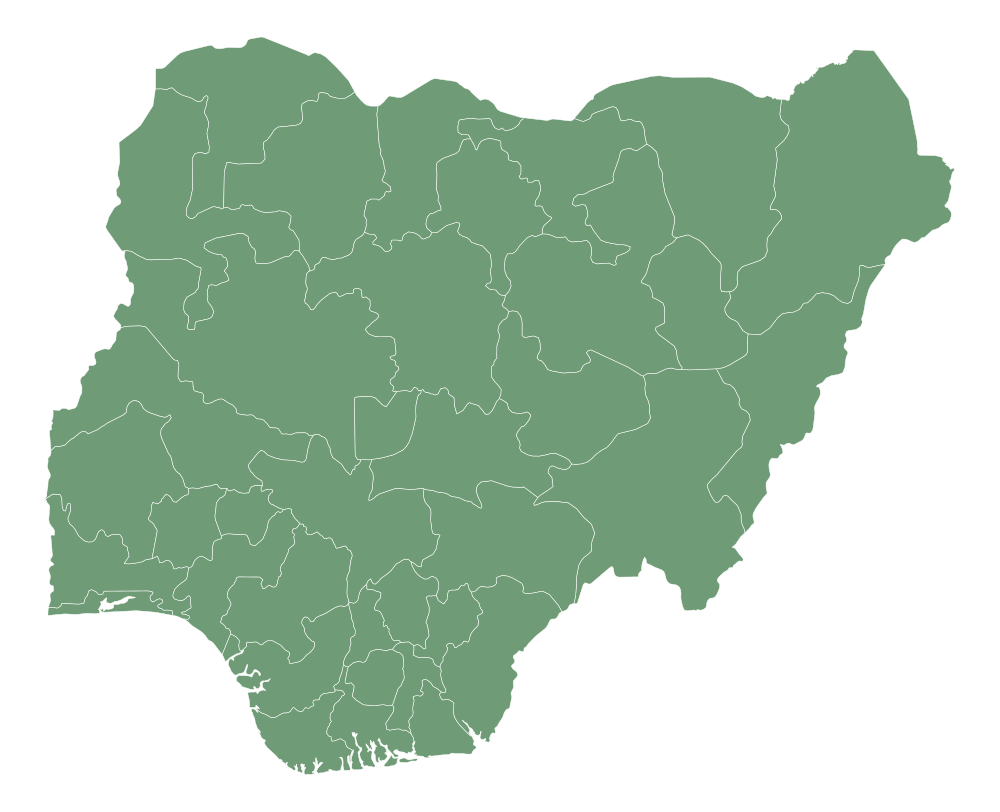
Geographic demand

Geographic Demand

State-level distribution of Accounting job market across Nigeria.

Research-period postings143.6K
Map of Nigeria showing state boundaries
Lagos
Abuja
Port Harcourt
Abeokuta
Ibadan
Industry hiring

Industry Hiring

Where most employers hiring Accounting graduates are concentrated by industry.

Research-period postings143.6K
Banking & Financial Services25.4%
Professional Services & Audit22.4%
FMCG & Consumer Goods16.4%
Fintech & Digital Payments13.4%
Manufacturing & Industrial11.9%
Oil & Gas / Energy10.4%

Industry shares are normalized from the values entered in the course research data. Posting counts are derived from the Demand Trend research-period total; they are not independent job-board counts.

Salary intelligence

Salary Intelligence

See advertised salary by experience, location and industry for Accountants career market.

Research period2026
Advertised range₦120K – ₦1.5MMonthly advertised salary for Accountants
Median advertised pay₦250KMonthly advertised salary for Accountants

By experience

Monthly advertised salary for Accountants
Entry-level₦80K – ₦250K
Mid-level₦250K – ₦500K
Senior Accountants₦500K – ₦1.5M
How to read these figures
Advertised salaries are not national averages. Pay varies by role, employer, experience, location and industry.
Employer requirements

Most required job experiences observed

See the experience levels employers commonly request for Accounting jobs in Nigeria 
2026
2-5 years 48.0%
0-2 years 34.0%
Fresh Graduates 18.0%
What this means
This means from all accounting job postings analysis we conducted, we observed that about 18% were looking for fresh Accounting graduates in Nigeria who just finished their NYSC
How to read this
Experience bands show how employer requirements are distributed across the analysed job postings.
Employer demand

Employer Skills Intelligence

See the skills employers most frequently request in job postings for this career.
2026
Advanced Microsoft Excel (pivot tables, VLOOKUP) alongside enterprise tools like QuickBooks, Sage, or SAP 48.0%
Ledger Management 33.0%
Power BI or Tableau 18.0%
Attention to Detail 9.0%
Time Management 5.0%
What employers are looking for

Accounting jobs in Nigeria generally require a degree or HND in Accounting, Finance or Economics, with ICAN/ACCA often preferred for higher-level roles, plus skills in financial reporting, IFRS and tax compliance, Excel and accounting software, bookkeeping, payroll and reconciliations, alongside strong analytical, communication, attention-to-detail and time-management abilities.

How to read this
Skill shares show the proportion of analysed job postings that explicitly requested or referenced each skill. As an Accounting student, graduate or aspirant, these are the skills you should build yourself with, because these are what most employers are looking for, based on our evidence of the job market demands in Nigeria
Professional requirements

Certifications Intelligence

See the professional certifications and qualifications employers most frequently mention for this career.
Over 52.4% of total jobs request ICAN certification analysed 2026
ICANProfessional certification
52.4%
ANANProfessional certification
21.0%
ACCAProfessional certification
18.0%
What this means
As an Accounting student, NYSC member or graduate, always have a plan to acquire at least one professional Accounting certification. The Accounting certification in Nigeria mostly listed as one of the jobs requirements is the the ICAN certificate. 

See How To Get ICAN Certification in Nigeria: Our Comprehensive Guide for Beginners.

How to read this
Certification shares show the proportion of analysed job postings that explicitly mentioned each certification or professional qualification. A job posting may mention more than one certification, so percentages do not need to total 100%.
Where you can work

Employer Directory

See employers and organisations that commonly hire for careers connected to this course.
2026

Deloitte

Professional

Locations: Lagos

Career areas: Audit

Relevant roles: Accountant

Entry level: Yes
How to read this
Employers are included because the research identified relevant roles or career areas connected to this course. Inclusion does not mean the employer is currently hiring.
From graduation to your first job

Fresh Graduate Reality

Practical steps for moving from final year to NYSC and your first serious job, based on the career-market evidence for this course.
2026
01

Before your final papers

Prepare your CV before your final papers. Build your LinkedIn profile, collect evidence of relevant projects or experience, and start tracking the skills and employers already identified in this career guide.
02

Before NYSC

Use the period before NYSC productively. Improve the practical skills employers request, complete relevant training where appropriate, and start building a target-employer list instead of waiting until POP to begin your job search.
03

Use NYSC strategically

Where to target
Lagos 58.5%Federal Capital Territory 14.0%Rivers 7.0%Ogun 4.0%Oyo 3.0%
Use your NYSC year strategically. Where you have legitimate and permissible choices, prioritise locations where this course has strong employer activity, and use your service year to build relevant experience and professional relationships.
04

During your PPA / service year

Treat your PPA as an opportunity to build real work experience. Take on relevant responsibilities where your role allows, learn the tools used in your field, keep evidence of meaningful work, and maintain an updated CV throughout the service year.
05

Don't wait for POP

Do not wait until NYSC POP before applying. Start checking graduate trainee and entry-level opportunities several months before POP, carefully checking each programme’s eligibility requirements because some accept serving corps members while others require NYSC completion.
What this means
A degree is a starting point, not the end of the process. The strongest transition plan combines relevant experience, employer-requested skills, targeted applications and early preparation.
Common mistakes to avoid
Waiting until POP to prepare a CV; sending one generic CV everywhere; treating NYSC as unrelated to your career; ignoring skills employers repeatedly request; and failing to track graduate trainee eligibility and application windows.
WORKFORCE CONTEXT

Vacancy evidence is not a workforce census

Careerlator does not infer the number of employed graduates from job-board listings. The current public snapshot is used as a market signal only.
COURSE COMPARISON

Where Accounting sits among leading Social Science courses

These percentages show the relative share of the observed market represented by the leading Social Science courses in our latest comparable research snapshot.
Accounting32.0%
Business Administration68.0%
These percentages show Careerlator's latest comparable share of observed employer recruitment activity across the leading Social Science courses in this research set.
LABOUR-MARKET DIRECTION

What employers are actually hiring Accountants to do

The degree name is only the starting point. Employers often advertise for a job function or role, then specify the skills, accounting software and experience needed to do it.
▦

Accounting Career functions

Accounting jobs in Nigeria have different roles and tasks descriptions, depending on the organisation or industry that's hiring. But the most common roles are Accounts officers, payroll managers, Auditing officers, etc
✓

Accounting Skills employers ask for

Most employers commonly ask for graduates with basic accounting skills like Excel, balancing sheets, auditing, attention to details and ability to use basic accounting softwares
⌘

Accounting tools and systems

Popular accounting tools like QuickBooks, Xero, FreshBooks, and Wave help businesses easily track their money, send invoices, and handle taxes.
Where the market is moving:

Is Accounting a good course to study in Nigeria in 2026?

High
Accounting has steady demand because companies, schools, hospitals, banks, NGOs and other organisations all need people who can handle money and records. Our research also shows that Accounting connects to several employer functions beyond the title Accountant, including audit, tax, finance, compliance, reporting, analysis and finance systems. 
This establishes strong and sustained employer demand across accounting and finance functions.

What is Accounting really about?

Accounting is the work behind financial records, reporting, controls, tax and the numbers organisations use to make decisions.
Accounting is about keeping financial records, checking money, preparing reports, handling tax and helping an organisation understand its finances.

What jobs can you get with an Accounting degree?

Accountant is only the obvious starting point. Audit, tax, finance operations and other commercial roles can open up as your experience grows.
You can work as an Accountant, Accounts Officer, Audit Assistant, Finance Officer, Tax Assistant or move into other finance roles. Your exact options depend on the employer and your professional qualifications.

Are accountants in demand in Nigeria?

Careerlator's employer-recruitment data shows sustained demand for accounting and finance functions across the Nigerian labour market.

How Easy Is It to Get a Job After Graduation?

Accounting graduates have plenty of job opportunities in Nigeria.

Banks, audit firms, companies, fintechs, government agencies, schools, hospitals, NGOs and other organisations are constantly looking for Accounting graduates.

As a fresh graduate, common entry-level jobs include Accounts Officer, Account Assistant, Audit Assistant, Finance Officer and Tax Assistant. You can also find roles in payroll, financial reporting, internal audit, credit and compliance.

One advantage of Accounting is that almost every organisation needs someone who understands its money and financial records. That gives you a wider job market to work with.

The first job might not be your dream job, and the salary might not be impressive at the beginning. But Accounting gives you a clear starting point, and you can move into better-paying roles as you gain experience and professional accounting certifications like ICAN, ANAN and ACCA.

How much do Accountants earn in Nigeria?

Accountants in Nigeria can earn about ₦80,000–₦150,000 monthly at entry level, rising to ₦250,000–₦600,000 with ICAN/ACCA, ₦600,000–₦1.2 million as senior accountants, and ₦1.2 million–₦8 million+ in finance management and CFO roles.
Some current adverts showed about ₦300k–₦400k a month, while one accountant advert showed ₦400k/month. A current accounting/finance snapshot also reported a ₦262,500 median among the openings that disclosed salary. Pay changes with experience, company, location and qualification. These figures represent salaries employers advertised for the roles identified in our research.

How much does it cost to study Accounting?

Studying Accounting in Nigeria can cost ₦45,000 to ₦3.5 million+ per academic session, depending on the institution, with federal universities generally costing ₦45,000–₦160,000, state universities ₦100,000–₦250,000, private universities ₦600,000–₦3.5 million+, and open/distance-learning programmes about ₦80,000–₦260,000, excluding expenses such as acceptance fees, textbooks, professional exams, accommodation and feeding.
There is no single price for this course. School fees can be very different from one university to another, and you also need to budget for accommodation, transport, books, materials and other school costs. We will show school-by-school figures when they are verified.

What are the admission requirements for Accounting?

To study Accounting in a Nigerian university, you generally need at least five O-Level credits including English Language, Mathematics and Economics, a suitable JAMB UTME subject combination (English, Mathematics, Economics and one relevant subject), and a UTME score that meets the university’s cut-off, while Direct Entry candidates may qualify with A-Level passes, a relevant ND/HND, or certain professional qualifications such as ICAN or ACCA, subject to each university’s specific requirements.
For admission, check the current JAMB/UTME subject combination, O-Level requirements and the specific university cut-off. Requirements can change from one school to another, so check the school before you apply.

What do Accounting students study at university?

Expect financial accounting, management accounting, tax, audit, economics, business law and quantitative work.
You will study the main ideas in the course and spend time building practical skills. Do not wait until final year before learning what employers expect.

What Accounting skills should you learn before graduation?

To succeed in the Nigerian job market after graduation, you must learn core accounting skills like practical tax filing (PIT, CIT, VAT), proficiency in popular accounting software, and data analysis using Advanced Microsoft Excel.


Start with Excel. Then learn accounting software, reporting, reconciliation, tax basics and how to explain numbers clearly. Try to build real work samples while you are in school.

Do you need ICAN, ACCA or another Accounting qualification?

Professional qualifications can change your options, but the right one depends on the direction you choose.
ICAN, ACCA, ACA and ANAN can matter, depending on the role and your career plan. Check the exact requirement for the job you want.

How do you get Accounting experience as a student?

An internship in an accounts department can teach you things lectures cannot. Start looking early.

Look for SIWES, internships, audit assistant roles, accounts assistant roles and graduate trainee programmes. Try to have real work experience before graduation.

Where can Accounting students find internships and graduate programmes?

Banks are not the only option. Look at companies, audit firms, NGOs, schools, hospitals and other organisations with finance teams.
Accounting internships in Nigeria—offered by elite Big Four firms like PwC and KPMG, top commercial banks, and multinationals—provide students with crucial hands-on experience in practical taxation, corporate auditing, and cloud bookkeeping software to bridge the gap between classroom theory and real-world employment.

Can NYSC help you get your first Accounting job?

Yes, NYSC helps you secure your first accounting job by granting access to competitive Big Four graduate schemes and providing corporate PPAs where exceptional performance during your service year frequently leads to permanent, full-time employment retention after graduation.

The National Youth Service Corps (NYSC) is a mandatory one-year program for Nigerian graduates that features a three-week orientation camp, an eleven-month corporate or community work placement (PPA), weekly local development projects (CDS), and a government-funded monthly stipend.

What scholarships can Accounting students apply for?

Search by your year of study and eligibility, and keep track of deadlines instead of relying on old scholarship lists.
Look for scholarships from universities, foundations, companies, government programmes and professional bodies. Check the deadline, CGPA and who is allowed to apply before you spend time on an application.

Is postgraduate study necessary for Accounting?

Not always. Professional qualification and relevant experience may be more useful for some paths; postgraduate study can help for others.

Can Accounting graduates work abroad?

Accounting knowledge travels, but professional recognition, tax rules and local reporting standards can change from country to country.
Overseas practice can involve qualification assessment and professional recognition.

What should you do from Year 1 to graduation?

The best time to prepare for the work is before final year. Your plan should match the kind of Accounting career you want, not just the calendar.
Year 1

Build strong academic foundations • Learn Excel well • Start tracking scholarships

Year 2

Learn accounting software • Seek practical exposure • Research professional certification

Year 3

Apply for internships • Build CV and references • Track graduate programmes

Final year

Complete relevant professional steps • Apply for entry-level roles • Prepare for interviews

Turn Accounting research into action

Use these course-specific routes to move from research to practical preparation. Each page keeps the Accounting context in the URL.
Self-assessment

Career Fit Tool

Answer a few quick questions to see how closely your interests, expectations and readiness align with this course and its career market.
1 / 6
01

I genuinely enjoy the subjects, problems or type of work connected to this course.

Accounting vs Business Administration: which course fits your career plan?

Both can lead into commercial work, but Accounting gives you a more defined professional path. Compare the entry requirements, professional exams, daily work and the roles you actually want.
Compare Accounting

Compare this course with 1–3 other courses

Build a focused 2–4 course comparison. The full comparison page uses the selected courses' own market evidence and writes the analysis around that exact combination.

The first course stays Accounting. Add up to three other courses.

Popular comparisons for AccountingOpen a full comparison with original analysis for the selected pair.
Accounting vs Business Administration
Compare courses →

Before you choose Accounting

Do not make the decision from one salary figure or one job-board count. Look at the work, the market evidence, the training, the professional requirements, where the jobs are and what you are willing to build during university.