CoursesAbout UsCompare
Banking and Finance Salary in Nigeria

Banking and Finance Salary in Nigeria, Jobs, Requirements and Career Paths

How much is Banking and Finance Salary in Nigeria? Is it a good course to study? 

If you are a student choosing a course, a parent paying tuition, or an NYSC corp member looking for a job, here is the honest truth: Banking and Finance is still a highly lucrative course in Nigeria, but only if you drop the old textbook mindset.

Our research data shows that between 2021 and 2025, the finance job market crashed because mobile apps wiped out traditional branch jobs like tellers. However, 2026 is a massive turning point. Thanks to the Central Bank forcing banks to inject ₦4.6 trillion in fresh capital, job postings are spiking vertically, and data models predict steady hiring growth all the way to 2031.

The catch is that banks aren't hiring cash-counters anymore; they are desperately fighting over fresh blood who understand data analytics, digital operations, and cyber-fraud prevention. If you graduate today with just a finance degree, you will struggle—but if you blend that degree with basic tech or data skills, you are stepping into one of the highest-paying and fastest-growing career paths in the country. 

Bookmark this page and share it with any Banking and Finance aspirant you know.

Is Banking and Finance a good course to study in Nigeria in 2026? →
Jobs opportunitiesHigh
Most required certificationICAN and CIBN
Most needed rolesFintech, product management, Data analytics, and digital operations


Monthly Salary₦200K – ₦500K for Entry and Mid-level roles
On This PageCourse overview
↗
How Careerlator reads the Banking and Finance labour market
For Banking and Finance, Careerlator tracks the job functions employers connect to the qualification and analyses the skills, tools, experience, certifications and professional requirements behind those roles.
MARKET TRENDHonestly, it's a tough but highly rewarding market right now; traditional bank teller roles are disappearing because of mobile apps, but if you have tech, data, or analytical skills, banks and fintechs are aggressively hiring and fighting to pay top naira for good talent.
Demand over time

Demand Trend

Looking at this chart, it's pretty clear that job postings took a massive hit after 2021 and just dragged along the bottom for a few years, but they finally shot way back up in 2026.

Going forward, the model predicts that the job market is going to slowly and steadily keep growing all the way to 2031, though that wide green shadow means there is still a lot of uncertainty about exactly how high or low it will actually go.

RecordedModel estimate14.5K11.6K8.7K5.8K2.9K0Job postings2027 — 5.5K model estimate2028 — 6K model estimate2029 — 6.4K model estimate2030 — 6.7K model estimate2031 — 7K model estimateFORECAST2021 — 2K recorded job postings2022 — 1.2K recorded job postings2023 — 1.4K recorded job postings2024 — 2.8K recorded job postings2025 — 820 recorded job postings2026 — 4.9K recorded job postings20212022202320242025202620272028202920302031Year
MODEL FORECAST

Where the market could be heading

Projected from the historical Demand Trend data. Forecasts are estimates, not guarantees.

5-year projection7Kmodel estimate for 2031 · range 0–14.3K
Approx. graduation outlook6.7Kmodel estimate for 2030 · range 141–13.3K
The shaded model range reflects increasing uncertainty with forecast distance. The model uses only the course's historical Demand Trend observations; it is an estimate, not a prediction guarantee, and actual future hiring can differ.
Trend interpretation
Geographic demand

Geographic Demand

State-level distribution of the course job market across Nigeria.
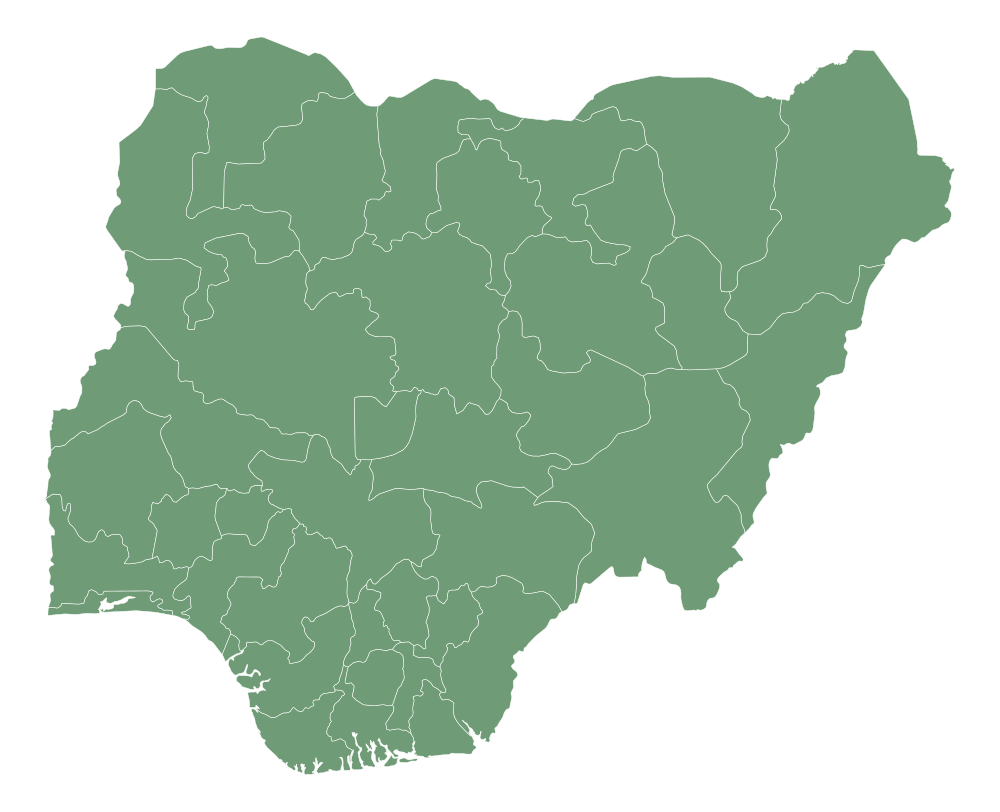
Research-period postings13.1K
Map of Nigeria showing state boundaries
Lagos
Abuja
Port Harcourt
Abeokuta
Ibadan
Industry hiring

Industry Hiring

Where employers hiring for this course are concentrated by industry.

Research-period postings13.1K
Banking & Fintech55.0%
Corporate Finance & Accounting20.0%
Professional Services & Consulting15.0%
Investment & Asset Management10.0%

Industry shares are normalized from the values entered in the course research data. Posting counts are derived from the Demand Trend research-period total; they are not independent job-board counts.

Salary intelligence

Salary Intelligence

See advertised pay by experience, location and industry for this career market.

Research periodJan - Sept 2026
Advertised range₦200K – ₦3.5MMonthly advertised salary
Median advertised pay₦450KMonthly advertised salary

By experience

Monthly advertised salary
Entry level₦150K – ₦450K
Covers outsourced tellers to tier-1 graduate trainees.
1-3 years₦350K – ₦800K
Senior analysts and early relationship managers.
3-5 years₦600K – ₦1.5M
Assistant managers, compliance officers, and fintech leads.
5+ years₦1.2M – ₦3.5M
Branch managers, senior risk managers, and directors.
How to read these figures
Advertised salaries are not national averages. Pay varies by role, employer, experience, location and industry.
Employer requirements

Experience Requirements

See the experience levels employers commonly request for this career.
4,850 Banking and Finance job postings analysed Jan - Sept 2026
Mid level (3-5 years) 45.0% The bulk of market demand; targeting specialized tech, risk, and compliance talent.
Entry level (0–2 years) 35.0% Driven heavily by annual graduate trainee intakes and retail contract roles.
Senior level (5+ years) 20.0% Management-level positions requiring regulatory CIBN or ICAN certifications.
What this means
What this data is basically telling us is that banks and fintechs are tired of training newbies from scratch—they are desperately looking for mid-level guys with 3 to 5 years of experience who can jump straight into the deep end. That’s why almost half of the job openings (45%) are targeted at people who already know how to handle data, build digital products, or stop cyber fraud without needing a handheld guide. If you are a fresh graduate or corper, don’t panic though; entry-level slots still make up a solid 35% of the market, but that's strictly because banks have fresh trillions from the recent capital rules to fund their yearly graduate trainee programs.
How to read this
Experience bands show how employer requirements are distributed across the analysed job postings.
Employer demand

Employer Skills Intelligence

See the skills employers most frequently request in job postings for this career.
4,850 Finance job postings analysed Jan - Sept 2026
Modeling & Excel 30.0% Non-negotiable baseline for credit analysis, risk management, and financial control.
SQL, PowerBI 25.0% Highly demanded for tracking transaction trends and consumer behavior.
Digital Product Mgt 20.0% Needed to build, test, and scale digital channels and app infrastructure.
Cybersecurity 15.0% Massive priority for protecting digital vaults from payment system vulnerabilities.
Deposit Mobilization 10.0% Traditional soft skill crucial for aggressive funding growth after recapitalization.
What employers are looking for
Long story short, employers are looking for people who can do way more than just balance an accounting book. Excel is still the absolute bare minimum baseline you need to even get your foot in the door for risk or credit roles, but the real premium salaries are going to people who know how to manipulate data with SQL or manage digital banking products. Because of the massive spike in mobile transactions this year, banks are desperately hunting for talent that can lock down security systems and prevent electronic fraud, while simultaneously headhunting aggressive relationship managers who can bring in major corporate deposits.
How to read this
Skill shares show the proportion of analysed job postings that explicitly requested or referenced each skill. They are not a measure of individual ability or guaranteed hiring requirements.
Professional requirements

Certifications Intelligence

See the professional certifications and qualifications employers most frequently mention for this career.
ICANProfessional qualification
40.0% The absolute gold standard for any accounting, internal control, or audit role.
CIBNProfessional qualification
30.0% Mandatory regulatory requirement for climbing into core bank management roles
ACCAProfessional qualification
18.0% Highly favored by fintechs, multinational firms, and the Big 4 audit houses.
CFAProfessional qualification
12.0% The premier choice for niche investment banking, asset management, and treasury.
How to read this
Certification shares show the proportion of analysed job postings that explicitly mentioned each certification or professional qualification. A job posting may mention more than one certification, so percentages do not need to total 100%.
From graduation to your first job

Fresh Graduate Reality

Practical steps for moving from final year to NYSC and your first serious job, based on the career-market evidence for this course.
01

Before your final papers

Prepare your CV before your final papers. Build your LinkedIn profile, collect evidence of relevant projects or experience, and start tracking the skills and employers already identified in this career guide.
02

Before NYSC

Use the period before NYSC productively. Improve the practical skills employers request, complete relevant training where appropriate, and start building a target-employer list instead of waiting until POP to begin your job search.
03

Use NYSC strategically

Where to target
Lagos 34.7%Federal Capital Territory 32.7%Rivers 17.3%Ogun 12.2%Oyo 2.0%
Use your NYSC year strategically. Where you have legitimate and permissible choices, prioritise locations where this course has strong employer activity, and use your service year to build relevant experience and professional relationships.
04

During your PPA / service year

Treat your PPA as an opportunity to build real work experience. Take on relevant responsibilities where your role allows, learn the tools used in your field, keep evidence of meaningful work, and maintain an updated CV throughout the service year.
05

Don't wait for POP

Do not wait until NYSC POP before applying. Start checking graduate trainee and entry-level opportunities several months before POP, carefully checking each programme’s eligibility requirements because some accept serving corps members while others require NYSC completion.
What this means
A degree is a starting point, not the end of the process. The strongest transition plan combines relevant experience, employer-requested skills, targeted applications and early preparation.
Common mistakes to avoid
Waiting until POP to prepare a CV; sending one generic CV everywhere; treating NYSC as unrelated to your career; ignoring skills employers repeatedly request; and failing to track graduate trainee eligibility and application windows.
WORKFORCE CONTEXT

Vacancy evidence is not a workforce census

Careerlator does not infer the number of employed graduates from job-board listings. The current public snapshot is used as a market signal only.
COURSE COMPARISON

Where Banking and Finance sits among leading Social Science courses

These percentages show the relative share of the observed market represented by the leading Social Science courses in our latest comparable research snapshot.
Accounting20.0%
Business Administration42.5%
Economics15.6%
Marketing20.5%
Public Administration1.4%
These percentages show Careerlator's latest comparable share of observed employer recruitment activity across the leading Social Science courses in this research set.
LABOUR-MARKET DIRECTION

What employers are actually hiring this course to do

The degree name is only the starting point. Employers often advertise for a job function or role, then specify the skills, software and experience needed to do it.
▦

Career functions

✓

Skills employers ask for

⌘

Tools and systems

Where the market is moving:

Is Banking and Finance a good course to study in Nigeria in 2026?

High
Banking and Finance gives you a clearer finance-oriented direction, with pathways into banking, credit, risk, finance operations, payments and commercial roles. The degree becomes more valuable when you add practical analysis, reporting and financial-systems skills.

What is Banking and Finance really about?

Let's talk about what Banking and Finance as a course is really about, so you know if it's a course you would want to study in Nigeria. 
Banking and Finance is about how money moves through banks, businesses and financial markets, and how organisations manage lending, risk, payments and investment.

What jobs can you get with a Banking and Finance degree?

Banking is only one route. Credit, risk, finance operations, payments, financial analysis and other commercial roles can also be part of your career path.
These are many Jobs opportunities for banking and finance graduates in Nigeria 

Is Banking and Finance in demand in Nigeria?

Yes. Banking and Finance has a broad job market in Nigeria, with opportunities across banks, fintech companies, microfinance institutions, investment firms, insurance companies and other businesses that need finance professionals. MyJobMag recorded 10,209 Finance/Accounting/Audit job openings in 2025, up 9.2% from 2024.

Banking and Finance can lead to more than traditional bank jobs. Graduates can work in banking operations, credit analysis, financial analysis, risk management, investment banking, treasury, auditing, compliance and financial sales.

Current Nigerian vacancies show opportunities across commercial banks, microfinance banks and other financial institutions. Recent roles include Credit Analyst, Loan Officer, Investment Banking Officer, Financial Analyst and Business Banker.

The course is particularly useful for students who build practical skills alongside their degree. Excel, financial analysis, accounting principles, financial modelling, communication and knowledge of financial regulations can make a Banking and Finance graduate more useful to employers.

How much do Banking and Finance graduates earn in Nigeria?

Pay changes with the role, employer, location, experience and the finance skills you bring to the job.
For fresh graduates, the advertised range is ₦150,000–₦450,000 per month. Roles requiring 1–3 years of experience advertise about ₦350,000–₦800,000, while 3–5 years can reach ₦600,000–₦1.5 million. Positions requiring 5+ years show advertised salaries of about ₦1.2 million–₦3.5 million per month.

How much does it cost to study Banking and Finance?

The cost depends heavily on the university. Public universities are generally cheaper, while private universities can cost much more. You should also budget for acceptance fees, accommodation, textbooks, registration and other school charges.

For Banking and Finance, your main cost is usually university fees, but the amount can vary widely from one institution to another.


Public universities: You may find total academic charges from around ₦80,000 to ₦250,000+ per session, depending on the university and whether you are a new or returning student.


Private universities: Fees can range from around ₦500,000 to ₦2 million+ per session, depending on the institution and what is included in the fee structure.

For example, Godfrey Okoye University listed Banking and Finance at ₦750,000 for 100 and 200 Level and ₦700,000 for 300 Level for 2025/2026.


Remember that the advertised school fee may not cover everything. Budget separately for acceptance fees, accommodation, textbooks, registration, departmental charges, transportation and other personal expenses.


Tip: Before choosing a university, check its latest official fee schedule. Fees can change from one academic session to another.

What are the admission requirements for Banking and Finance?

Check the current JAMB and university requirements for the exact Banking and Finance programme you want to study.

For a typical UTME admission into Banking and Finance, you should have:


  • Five O’Level credit passes, including English Language and Mathematics.
  • The required credits should normally be obtained in not more than two sittings.
  • A valid UTME result with the required subject combination.
  • English Language is compulsory in the UTME.
  • Other UTME subjects commonly include Mathematics, Economics and one other relevant subject, but the exact combination can vary by institution.


For Direct Entry, universities may accept qualifications such as ND, HND, NCE, IJMB, JUPEB or relevant A-Level qualifications, depending on the institution and programme.


Important: There is no single admission requirement that applies identically to every Nigerian university. JAMB's IBASS Eligibility Checker allows you to select your institution and programme and verify the exact O'Level and UTME requirements before applying.


CareerLator tip: Don't put a fixed JAMB score here unless we're attaching it to a specific university and admission year. The requirements can differ by institution, and JAMB itself directs candidates to IBASS to verify the correct combination.

What do Banking and Finance students study at university?

You will study how banks, financial institutions and businesses manage money, investments, credit and financial risk.

Banking and Finance covers both financial theory and practical business skills. Depending on your university, you may study subjects such as:

  • Principles of Banking
  • Financial Accounting
  • Economics
  • Business Mathematics
  • Statistics
  • Financial Management
  • Money and Banking
  • Investment Analysis
  • Financial Markets
  • Risk Management
  • Credit Management
  • Bank Management
  • Corporate Finance
  • Insurance
  • Taxation
  • Auditing
  • Entrepreneurship
  • Management Information Systems

As you progress, the courses usually become more specialised, helping you understand how financial institutions operate, how businesses make financial decisions, and how to analyse financial information.

The exact course structure varies by university, so students should check the curriculum of their chosen institution before admission.

What Banking and Finance skills should you learn before graduation?

Your degree gives you the foundation, but practical skills can make it easier to compete for internships and entry-level jobs.

Before graduation, try to build these practical skills:

  • Microsoft Excel — formulas, PivotTables, charts and financial analysis.
  • Financial analysis — understand income statements, balance sheets and cash flow statements.
  • Accounting — know basic accounting principles and how financial transactions are recorded.
  • Financial modelling — learn how to build simple models for forecasting revenue, expenses and cash flow.
  • Data analysis — work with financial data and turn it into useful information.
  • Credit analysis — understand how lenders assess borrowers and credit risk.
  • Risk management — learn how banks and businesses identify and manage financial risks.
  • Communication — explain financial information clearly in writing and when speaking.
  • Digital banking and fintech — understand how technology is changing payments, lending and financial services.
  • Financial regulations and compliance — learn the basic rules that govern banks and other financial institutions.

Extra advantage: Get internship or work experience before graduation if you can. Practical experience plus skills such as Excel, financial analysis and data analysis can give you something concrete to show employers.

Do you need CIBN, ICAN, ACCA, CFA or another qualification?

A Banking and Finance degree can get you started, but a professional qualification can strengthen your profile for certain career paths. You do not need to collect every qualification — choose one that matches the type of work you want to do.

CIBN/ACIB — Banking


If you want to build a career specifically in banking, CIBN's Chartered Banker (ACIB) qualification is one of the professional routes to consider. CIBN has a specific route for university graduates in Banking and Finance, with exemptions based on the relevance of their degree.


ICAN/ACA — Accounting and finance


ICAN can be useful if you want to move towards accounting, audit, financial reporting, taxation or related finance roles. A recognised university degree or HND is among the qualifications accepted for professional student registration.


ACCA — Accounting and international finance

ACCA is another professional accounting qualification and can be considered if you want an accounting-focused career or an internationally recognised accounting qualification.

CFA — Investment and financial analysis

CFA is more specialised toward investment analysis, portfolio management and related investment careers. It is not a requirement for a normal banking career.

Other qualifications

Depending on your career direction, you may also consider qualifications or certifications in areas such as risk management, financial modelling, data analysis, compliance, taxation or investment.


The simple rule: 

Don't pursue a qualification just because someone says you need it. First decide whether you want to work in commercial banking, investment, accounting, audit, fintech, risk, compliance or financial analysis, then choose the qualification that supports that path.

How do you get Banking and Finance experience as a student?

Most commonly avenues are:
SIWES, internships, bank placements, finance roles and graduate trainee programmes can help you turn classroom knowledge into practical experience.

Where can Banking and Finance students find internships and graduate programmes?

Look beyond commercial banks. Fintechs, financial companies, investment firms and corporate finance teams can also provide useful early-career experience.
These are major employers.

Can NYSC help you get your first Banking and Finance job?

Use NYSC to gain practical finance experience, build professional contacts and learn how financial organisations operate.

What scholarships can Banking and Finance students apply for?

Search for scholarships using your course, study level and eligibility, and always check the current application deadline.

Is postgraduate study necessary for Banking and Finance?

Not always. Relevant experience, technical skills and professional qualifications may matter more for some roles, while postgraduate study can help for others.

Can Banking and Finance graduates work abroad?

Finance skills can transfer internationally, but professional recognition, local regulations, financial markets and employer requirements vary by country.
Yes. Banking and Finance graduates can pursue finance-related careers in other countries, but your degree does not automatically give you the right to work there. Your qualifications, skills, work experience and the immigration rules of the country you choose will all matter.


International Opportunities Detail content

A Banking and Finance degree can be relevant to jobs such as:

Financial Analyst

Banking Officer Credit Analyst Financial Advisor Accountant Auditor Risk Analyst Compliance Officer Investment Analyst Treasury Officer Finance Officer

For example, Canada's occupational classification includes financial analysts, financial advisors, auditors and accountants, securities professionals and other financial officers among its professional occupations.


Your chances can improve when you combine your degree with relevant work experience, strong Excel and financial-analysis skills, professional qualifications and good communication skills.

You should also check whether your target role requires local certification or registration. Requirements differ between countries and professions

What should you do from Year 1 to graduation?

The best time to prepare for the work is before final year. Your plan should match the kind of Banking and Finance career you want, not just the calendar.

Turn Banking and Finance research into action

Use these course-specific routes to move from research to practical preparation. Each page keeps the Banking and Finance context in the URL.
Self-assessment

Career Fit Tool

Answer a few quick questions to see how closely your interests, expectations and readiness align with this course and its career market.
1 / 6
01

I genuinely enjoy the subjects, problems or type of work connected to this course.

Compare Banking and Finance with similar courses

Compare the actual work, market evidence, entry route and skills before you decide.
Compare Banking and Finance

Compare this course with 1–3 other courses

Build a focused 2–4 course comparison. The full comparison page uses the selected courses' own market evidence and writes the analysis around that exact combination.

The first course stays Banking and Finance. Add up to three other courses.

Popular comparisons for Banking and FinanceOpen a full comparison with original analysis for the selected pair.
Banking and Finance vs Business Administration
Compare job demand, entry route, skills, pay and professional requirements.
Compare →
Banking and Finance vs Accounting
Compare job demand, entry route, skills, pay and professional requirements.
Compare →

Before you choose Banking and Finance

Do not make the decision from one salary figure or one job-board count. Look at the work, the market evidence, the training, the professional requirements, where the jobs are and what you are willing to build during university.